That’s not how you optimize performance. Aeration systems shouldn’t be treated that way either.
For many plants, aeration has been assembled through component selection: a diffuser here, a blower there, controls added on top. Each part may be high quality, yet the overall system may still fall short of its potential—because the performance depends on the interaction between components.
The shift: component optimization isn’t enough
Aeration is one of the largest energy expenses in a wastewater facility. When inefficiency exists, it’s not always inside a single component.
It often lives in mismatched sizing, gaps in oxygen demand modeling, airflow distribution that doesn’t fully capitalize on diffuser performance, and control strategies that can’t adapt in a way in which the system is actually capable.
What “integrated” really means
A high-performing aeration system is designed as one engineered whole. A useful way to think about it is through four “organs”:
- System Engineering (Spine): model oxygen demand and design around real biological needs
- Diffuser Technology (Lungs): efficient oxygen transfer matched to application and demand
- Blower Technology (Heart): right-sized air generation matched to the system’s true airflow needs
- Process Control (Brain): demand-driven control that adapts to load conditions instead of running blind to a fixed setpoint
Why integration creates measurable savings
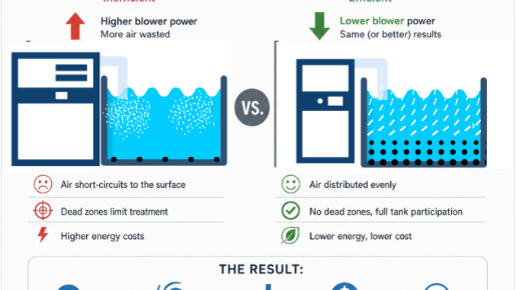
When diffusion efficiency improves and the system is designed to capitalize on it, required airflow often drops. That can mean right-sized blowers and reduced chronic energy waste—plus more consistent performance that reduces operational chasing.
In other words: the benefit of one improvement cascades through the entire system when it’s engineered together.
Why this matters now
Energy costs and performance expectations keep increasing. Plants don’t have time to “optimize in pieces.” The most sustainable path is engineering aeration as a system, not assembling it from components and hoping the interaction works out.
Case study: Roskow — fewer blowers, better outcomes
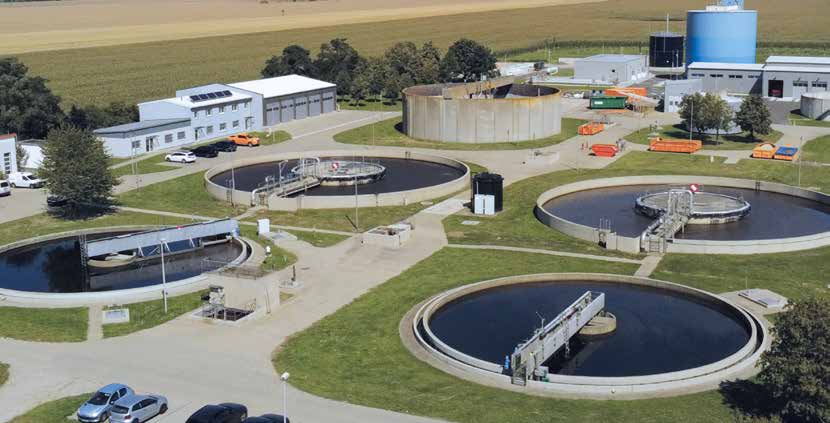
A clear example is the Roskow wastewater treatment plant, where the modernization effort focused on optimization across blower technology, aeration elements, and overall system design (not just swapping equipment). Previously, rotary lobe compressors and positive displacement blowers (2× GM25S) supplied oxygen to aeration tanks 1 and 2. After the integrated upgrade, the plant replaced this setup with five turbo blowers total—but critically, the operation was optimized so that only two machines run on average (one AT50 per tank), rather than maintaining a larger “just in case” operating burden.
The result was 330,000 kWh less energy consumption annually, alongside a 36% capacity increase (from 36,000 to 49,000 PE)—showing how integrated design can change not only performance, but also how many assets you actually need to run day to day.
Where Aquarius fits
At Aquarius Technologies, we build fine bubble aeration systems with precision manufacturing and the systems thinking required to engineer performance—not just specify parts.
If aeration is your biggest energy expense, the most valuable question may no longer be “Which component is best?”
It may be: Is your aeration engineered as one integrated system?