But aeration diffusers are the rare piece of equipment that punishes that philosophy—because they rarely "break." They just quietly get worse, and take your energy budget down with them.
Consider this: aeration typically accounts for 60 to 70 percent of a wastewater treatment plant's total energy consumption. It's the single largest energy line item you have—which means a slowly degrading diffuser system isn't a minor inefficiency. It's a leak in your biggest bucket.
Failure You Can't See Day-to-Day
Diffusers don't fail with a bang. They degrade by degrees. It's the boiling-frog problem: the daily change is too small to notice, but over months and years it adds up to a system that costs far more to run than the one you installed.
That slow decline shows up in three places:
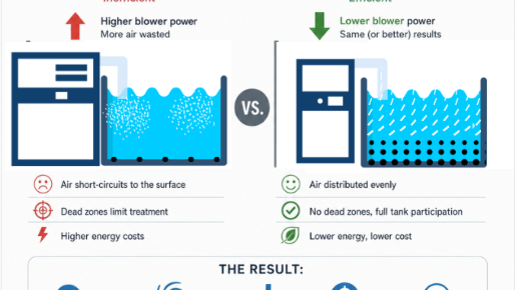
1. Energy efficiency erosion. Fouling, material fatigue, and wear steadily reduce oxygen transfer efficiency. Your blowers compensate by working harder to hit the same dissolved oxygen setpoints—burning more kilowatts every year to do the exact same job.
2. Treatment quality variability. As performance drifts unit-to-unit, aeration stops being uniform. Dead zones of poor oxygenation force the rest of the basin to overwork, which shows up as inconsistent BOD/COD removal and nitrification hiccups that seem to come out of nowhere. Causing solids to settle at the bottom of the tank, yielding diffuser inoperable in some cases and risk damaging the whole diffuser system from the diffusers themselves to piping and other components.
3. The maintenance cascade. What starts as "clean them a little more often" becomes component swaps, distribution tweaks, and eventually system-wide repairs. Every intervention eats labor hours, budget, and uptime.
How to Know When You've Crossed the Line
- Energy costs trending up despite stable influent characteristics
- More frequent complaints about variability from downstream processes
- Maintenance logs showing rising diffuser-related interventions
- Struggling to hit treatment targets during peak loads
- Visibly uneven aeration patterns in your basins
If you're nodding at two or three of these, your "good enough" system has probably already tipped into "costing you money."
Why Manufacturing Precision Actually Matters
Not all replacement diffusers are created equal—and this is where most buying decisions go wrong. Our Quantaer Fine Bubble Aeration System is built for uniformity from the joint up:
- Factory-welded holders. Diffuser holders are solvent- and ultrasonic-welded to the pipe, creating a mechanical bond stronger than the pipe itself—no field-installed holders, no field-sealing gaskets that fail.
- Four-sided O-ring compression at the joint (versus the two-sided compression common on comparable systems), with a thicker retainer ring and greater thread profile.
- Anti-rotational joints with infinite angular rotation that reduce joint stress, cutting the risk of leaks and failure.
- An advanced EPDM membrane blend with less than 10 percent extractable oils, plus an integral check valve that prevents backflow during intermittent operation.
Design decisions like these only matter if they hold up in production—so we verify them before anything ships. Diffuser holder assemblies undergo torque and impact testing against Aquarius QA/QC procedures. Membranes are checked for Dynamic Wet Pressure and uniformity under MIL-STD 105-E sampling protocols, if specified. Piping is fabricated by ASME-certified welders and passivated per ASTM A-380.
Our precision automation leads to unit-to-unit consistency and is what keeps your blowers from over-compensating for the weakest zone in the basin—and it's measured, not assumed.
The Financial Reality
Yes, replacement is a capital expense. But an inefficient system is an operating expense that never stops—and quietly grows.
Quantaer's engineered perforation pattern improves oxygen transfer efficiency, which often means fewer diffusers required to hit your performance targets. Combine that with a 7–10 year membrane life (up to 20 years for ceramic) and optional Clean-in-Place cleaning that doesn't require dewatering your basins, and the total-cost-of-ownership math shifts hard toward replacement.
The real question usually isn't can we afford to replace them? It's can we afford to keep running them?
A Smarter Replacement Strategy
- Evaluate current system performance honestly
- Document your energy consumption and treatment variability
- Factor in expansion plans that could change aeration demand
- Compare options on total cost of ownership, not sticker price
- Sequence installation to minimize operational disruption
One more advantage worth mentioning: we meet BABA compliance standards. Every Quantaer component is designed, sourced, and fabricated in the United States. That means a repeatable, controllable quality standard—and supply-chain reliability that matters more every year.
We know operators live in the tension between today's demands and tomorrow's planning. We'd welcome a conversation about your specific situation—and whether precision-manufactured diffusers can solve your current headaches while setting your facility up for what's next.