Microorganisms that break down organic matter need oxygen, and the standard way to supply it is a diffused aeration system fed by blowers.
That approach is reliable and widely used. How it gets designed is a different story.
The Component Trap
In many projects, the parts of an aeration system are treated as separate purchases:
- Diffusers are picked to meet oxygen transfer requirements.
- Blowers are sized to deliver airflow, often with generous safety margins.
- Controls are added at the end to tie everything together.
Each choice can look reasonable by itself. But aeration isn't a set of independent parts. It's one biological process, and the diffusers, blowers, and controls all depend on each other.
What Goes Wrong
According to Aerzen Water Treatment Systems, separate design often leads to three problems:
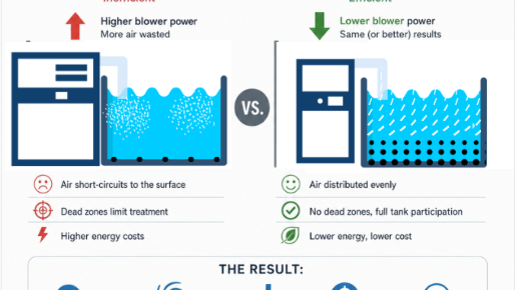
1. Oversized equipment. When each component carries its own safety margin, the margins stack up. Blowers can end up much larger than the process needs, so they run inefficiently for most of their working life.
2. Improper engineering. Problems tend to show up where the components connect. The diffuser layout may not match the blower's turndown range. Piping and airflow distribution may not reflect how demand actually changes.
3. Controls that aren't optimized. Controls added late often can't make full use of the equipment they manage. The result is aeration that runs steady while process demand rises and falls.
Why It Matters
Biological treatment is dynamic. Influent loads change by the hour, the season, and the community's growth. A system built from separately designed parts has a hard time keeping up, and the plant pays in wasted energy, extra wear, and equipment that never runs at its best.
A Different Starting Point
The alternative is to design the diffusers, blowers, and controls together from the start, as one process.
Watch the full video from Aerzen Water Treatment Systems on Wastewater Digest →