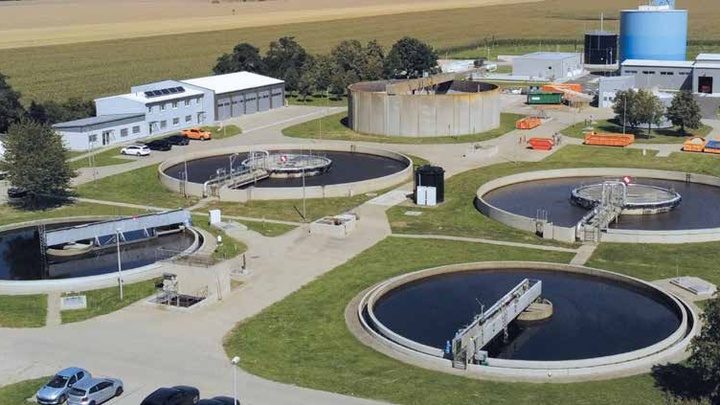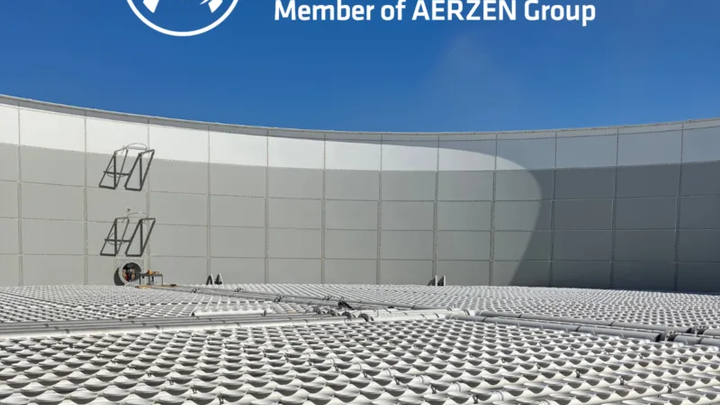
The shift we highlighted is simple: integrated aeration—engineering diffusers, air generation, and controls to work as one designed system—creates performance outcomes that component-level tuning usually can’t.
Here’s what that means in practical terms for plants.
1) Your largest energy expense becomes an operating lever
Aeration is often 60–70% of plant energy consumption. In a component-based approach, that cost is treated as a fixed reality: maintain equipment and pay the bill.
Integrated design turns aeration into a controllable lever by aligning oxygen demand modeling with the aeration hardware’s real capabilities—so the system runs efficiently based on what the biology needs, not what the hardware was simply selected to do.
2) Oversizing stops being “insurance” and starts being avoidable waste
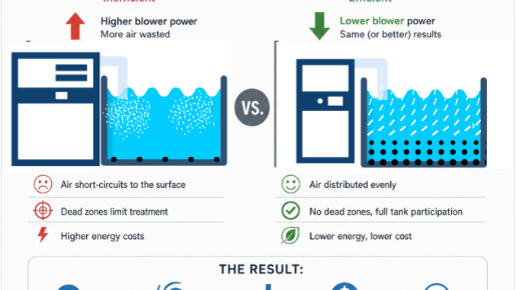
Traditional designs commonly oversize blowers for safety and flexibility. But oversizing doesn’t just increase capital cost—it often increases chronic energy waste, especially at partial load.
Integrated systems are designed around real demand and system-level interaction. That supports right-sized equipment rather than perpetually running “too much air.”
3) Controls finally match system behavior
In many plants, DO control is a constant balancing act: operators chase setpoints while air delivery behavior and diffusion performance interact in ways the original design didn’t fully anticipate.
Demand-driven, intelligent control—paired to the engineered system—improves consistency and reduces the need for manual chasing.
4) One accountable system design reduces finger-pointing
When diffusers, blowers, and controls are integrated and engineered together, accountability is clearer.
Instead of performance gaps becoming a vendor-by-vendor debate, one system design intent drives the outcome.
5) You get headroom for what’s coming next
Tightening limits, operational pressure, and energy sustainability expectations aren’t easing. Integrated aeration gives facilities better flexibility to meet performance needs without rebuilding the whole approach every time the requirements shift.
The bottom line
What we demonstrated at WEFTEC reinforces what we’ve been saying: aeration should be engineered as one integrated system—not built by assembling parts one by one.
If aeration is your largest energy expense, the most valuable next step is to evaluate your current approach against an integrated systems design and identify changes that can improve energy use, performance, and reliability across the board.