But what if the better solution is to add more diffusers? It could be that your aeration is undersized, not your blowers. Adding more diffusers is typically more economical than replacing blowers or upgrading to a bigger blower size.
It may sound counterintuitive, but in a properly designed wastewater aeration system, increasing the number and improving the distribution of diffusers can reduce the airflow—and potentially the blower power—required to meet the same oxygen demand.
The reason is simple: aeration efficiency depends not only on how much air enters the tank, but on how effectively that air is distributed and transferred into the wastewater.
Your Process Doesn’t Need More Air. It Needs More Useful Oxygen.
A blower supplies the pressure and airflow needed to push air through submerged diffusers. Those diffusers then divide the air into bubbles, creating the surface area needed for oxygen transfer.
However, injecting more air does not automatically mean transferring more useful oxygen. If operated at too high of an airflow per diffuser, can result in loss of O2 transfer efficiency due to bubble coalescing.
Performance also depends on:
- Bubble size: Fine bubbles generally provide more surface area for oxygen transfer.
- Bubble residence time: The longer bubbles remain submerged, the more opportunity oxygen has to dissolve.
- Diffuser coverage: Sufficient diffuser coverage is necessary for the air to be distributed across the tank rather than concentrated in a few areas.
- Mixing and circulation: Oxygenated water must reach the entire process volume.
- Tank hydraulics: Poor circulation can allow bubbles to rise and escape before their oxygen is effectively used.
The real objective is not maximum airflow. It is maximum useful oxygen transfer for every unit of blower energy consumed. This is only possible if the diffuser system is designed for optimal operating airflow range per diffuser.
Why More Diffusers Can Help the Blower Do Less
1. Better Coverage Reduces Dead Zones
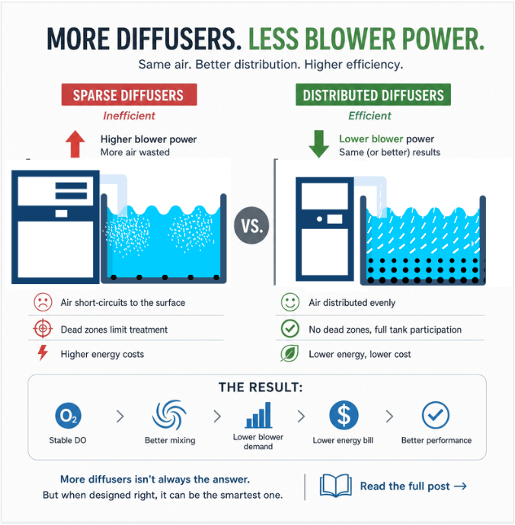
When too few diffusers serve a large tank, airflow becomes concentrated around a limited number of bubble plumes.
This can create areas of intense aeration near the diffusers, dissolved-oxygen hot spots, poorly mixed or oxygen-deficient zones elsewhere, and uneven biological treatment conditions.
Operators may compensate by increasing airflow to maintain the required dissolved-oxygen level throughout the tank. But that often means over-aerating one area just to reach another.
A well-distributed diffuser layout spreads aeration across a larger portion of the tank. This helps the available air do more useful work before it reaches the surface.
2. Lower Airflow per Diffuser Can Improve Efficiency
When the same total airflow is divided among more diffusers, each diffuser operates at a lower airflow rate. This also reduces back pressure on the blower system, which optimizes blower and diffuser operation.
Within the diffuser’s recommended operating range, this can support finer, more controlled bubble release and improve oxygen-transfer efficiency. It may also reduce excessive turbulence and coalescence, where smaller bubbles combine into larger bubbles with less surface area relative to their volume.
Instead of forcing a large volume of air through a small number of outlets, the system distributes it more evenly through many outlets.
More air-release points can mean better use of less total air.
3. Distributed Bubble Plumes Improve Mixing
Fine-bubble aeration does more than supply oxygen. Rising bubbles create water movement, circulation, and mixing.
With properly spaced diffusers, these bubble plumes can generate more uniform circulation throughout the tank. Better mixing helps:
- Move oxygenated water through the process
- Keep biological solids in suspension
- Reduce stagnant areas
- Improve contact between oxygen and biomass
- Maintain more consistent dissolved-oxygen conditions
When the whole tank participates in treatment, the blower does not need to work as hard to compensate for poor distribution.
4. More Stable DO Means Less “Chasing”
Poor diffuser coverage can make dissolved oxygen difficult to control. One part of the tank may have more oxygen than necessary while another remains below its target.
During changes in loading, temperature or wastewater characteristics, operators, or control systems may respond by repeatedly increasing airflow. This “chasing” can cause unstable operation and unnecessary energy consumption.
A properly distributed diffuser system can provide a smoother response by:
- Reducing localized DO extremes
- Maintaining more uniform oxygenation
- Responding more predictably to process changes
- Allowing airflow controls to operate closer to actual demand
The result may be lower average airflow, more stable blower operation, and reduced energy use.
The Important Catch: More Is Not Automatically Better
Adding diffusers is not a guaranteed shortcut to energy savings.
The number of diffusers must be matched to the tank, the oxygen demand, and the blower system. If diffusers are added without considering the complete design, they may provide little benefit—or create new operational problems.
An effective design should account for:
- Optimal airflow ranger per diffuser
- Diffuser type, size, and operating range
- Diffuser density, spacing, and placement
- Tank dimensions and water depth
- Wastewater characteristics
- Treatment objectives
- Peak and average oxygen demand
- Required mixing intensity
- Air-header and piping losses
- Diffuser pressure drop and backpressure
- Blower turndown and control range
- Membrane fouling, clogging, and maintenance access
Blower energy depends on both airflow and discharge pressure. Increasing diffuser area may reduce airflow-related losses and improve oxygen-transfer efficiency, but the blower must still overcome the tank’s static water depth and other system losses.
That is why the goal is not simply to install the greatest possible number of diffusers. The goal is to identify the optimal combination of diffuser coverage, airflow, pressure, and blower performance.
Questions Operators and Engineers Should Ask
Before increasing blower output or investing in a larger machine, consider asking:
- Is the tank under-diffused or unevenly aerated?
- Are there DO hot spots and oxygen-deficient zones?
- Is too much air being pushed through too few diffusers?
- Are the diffusers operating within their recommended airflow range?
- Does the actual airflow distribution match the original design?
- Are fouling or piping losses increasing blower pressure?
- Could better diffuser coverage meet the oxygen demand with less total airflow?
Sometimes the answer is not “turn up the blower.”
It may be: Improve the distribution, increase the effective diffuser area, and let the blower do less.
The Bottom Line
In a properly engineered system, more diffusers can improve bubble distribution, mixing, and oxygen-transfer efficiency. That may allow the plant to meet the same process demand with less airflow—and potentially less blower power.
It is not about adding equipment for the sake of adding equipment. It is about making every bubble count.
Could More Diffusers Let Your Blowers Do Less?
Not sure whether your current aeration system is working harder than it should? Talk to us. The answer may not be a bigger blower—it may be a smarter diffuser layout.
We can help identify the optimal combination of blowers, diffuser type, diffuser density, and airflow control for your plant—delivering the oxygen your process needs without wasting energy it doesn’t.
Get in touch to find your plant’s optimal blower-and-diffuser configuration.